
-
 Vendor:Paul Hartmann AG
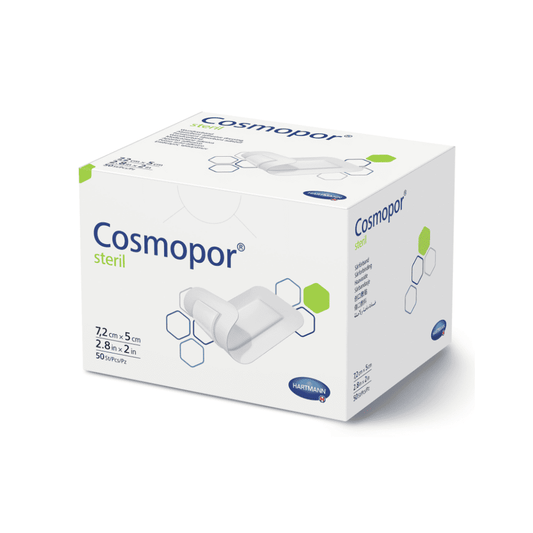
Hartmann Cosmopor® sterile wound association 7.2 x 5 cm
Only 13 leftRegular price From CHF 1.17Sale price From CHF 1.17 Regular priceUnit price perCHF 1.17 -
 Vendor:Paul Hartmann AG
Hartmann Cosmopor® sterile wound pad - 25 pieces
Regular price From CHF 7.49Sale price From CHF 7.49 Regular priceUnit price perCHF 7.49 -

 Vendor:Paul Hartmann AG
Hartmann Cosmopor® sterile wound association - 5 pieces
Regular price From CHF 1.80Sale price From CHF 1.80 Regular priceUnit price perCHF 1.80 -

 Vendor:Paul Hartmann AG
Hartmann Cosmopor® Waterproof wound association, waterproof, 7.2 x 5 cm | Pack (5 pieces)
Only 5 leftRegular price CHF 1.96Sale price CHF 1.96 Regular priceUnit price perCHF 1.96 -
 Vendor:Paul Hartmann AG
Hartmann Cosmopor® Advance Post-Op association-various sizes
Regular price From CHF 3.83Sale price From CHF 3.83 Regular priceUnit price perCHF 3.83 -

 Vendor:Paul Hartmann AG
Cosmopor Transparent Sterile Transparent Association
Only 15 leftRegular price From CHF 3.30Sale price From CHF 3.30 Regular priceUnit price perCHF 3.30 -
 Up to 12% offVendor:Paul Hartmann AG
Hartmann Atrauman® Silicone - 10 pieces
Only 8 leftRegular price From CHF 38.48Sale price From CHF 38.48 Regular priceUnit price perCHF 38.48 -

 Vendor:Paul Hartmann AG
Hartmann Atrauman® Sterile ointment compress
Regular price From CHF 14.84Sale price From CHF 14.84 Regular priceUnit price perCHF 14.84 -
 Vendor:BSN Medical GmbH
BSN CUTIMED® SORBION® plus wound contact layer
Only 2 leftRegular price CHF 86.10Sale price CHF 86.10 Regular priceUnit price perCHF 86.10 -
 Vendor:Paul Hartmann AG
Hartmann Atrauman Silicone
Regular price From CHF 77.94Sale price From CHF 77.94 Regular priceUnit price perCHF 77.94 -
 Vendor:Paul Hartmann AG
Hartmann Atrauman ointment compr
Regular price From CHF 27.85Sale price From CHF 27.85 Regular priceUnit price perCHF 27.85



The treatment of wounds requires special care and the right steps with selected materials to ensure optimal healing and prevent infections. Wound contact layers play an important role in wound care. Their main tasks are to protect the wound, keep it moist, and prevent sticking to the wound. Wound contact layers have direct contact with the wound and are crucial for the healing process.
The role of the wound contact layer in wound care
- Cleaning the wound: The first step is to clean the wound to remove dirt and foreign bodies. This is important because this step lays the foundation for further wound care.
- Wound contact layer: The next step is to select the appropriate wound contact layer and apply it to the wound. Depending on the type of wound, a specific dressing is suitable.
- Secondary covering: In the final step, the wound contact layer must be secured with a secondary covering such as a bandage. This ensures that the dressing stays in place and cannot slip. This step also protects the wound from external influences and allows the wound contact layer to remain optimally on the wound for a longer period.
The appropriate wound contact layers
Depending on the type of wound, the appropriate wound contact layer must be selected.
- Dry or slightly oozing wounds: Ointment compresses are specially designed wound contact layers made of cotton and impregnated with a neutral ointment mass. They keep wound surfaces supple and protect them from sticking. Ointment compresses are suitable for large abrasions or in plastic surgery and dermatology for burns or skin grafts.
- Wounds with irregular texture: Ointment tulle is another form of wound contact layer. It is a Vaseline-impregnated gauze tulle that prevents sticking to the wound. It can be cut to the desired size and then fixed on the wound with secondary bandages. Due to its flexible texture, it can adapt to different shapes of wounds.
- Infection-prone wounds: Silver-containing ointment compresses have antibacterial properties. The silver-containing coating kills a wide range of bacteria that could reach the wound. This property can help prevent infections and speed up the healing process. These special wound contact layers are designed to create a sterile environment and prevent the spread of germs.
- For highly exuding wounds: Ointment compresses with Paraffin are particularly suitable for the treatment of highly exuding wounds. This special compress is impermeable to secretions and also prevents sticking to the wound. Thus, the dressing change can be painless and the healing process is not negatively affected.
Conclusion on wound contact layers
Wound contact layers make a significant contribution to wound care. They promote quick and complication-free healing by minimizing the risk of infection and protecting the wound from external influences during the healing process. Wound contact layers come in different types that are tailored to various wounds and patients. Each wound contact layer offers its own benefits for the needs of the respective wound. Selecting the appropriate compress can significantly facilitate the healing process, reduce patient pain, and minimize the risk of infection. Discover the wide range of different wound contact layers, as well as other products for wound care and everything related to health and hygiene at Altruan.


